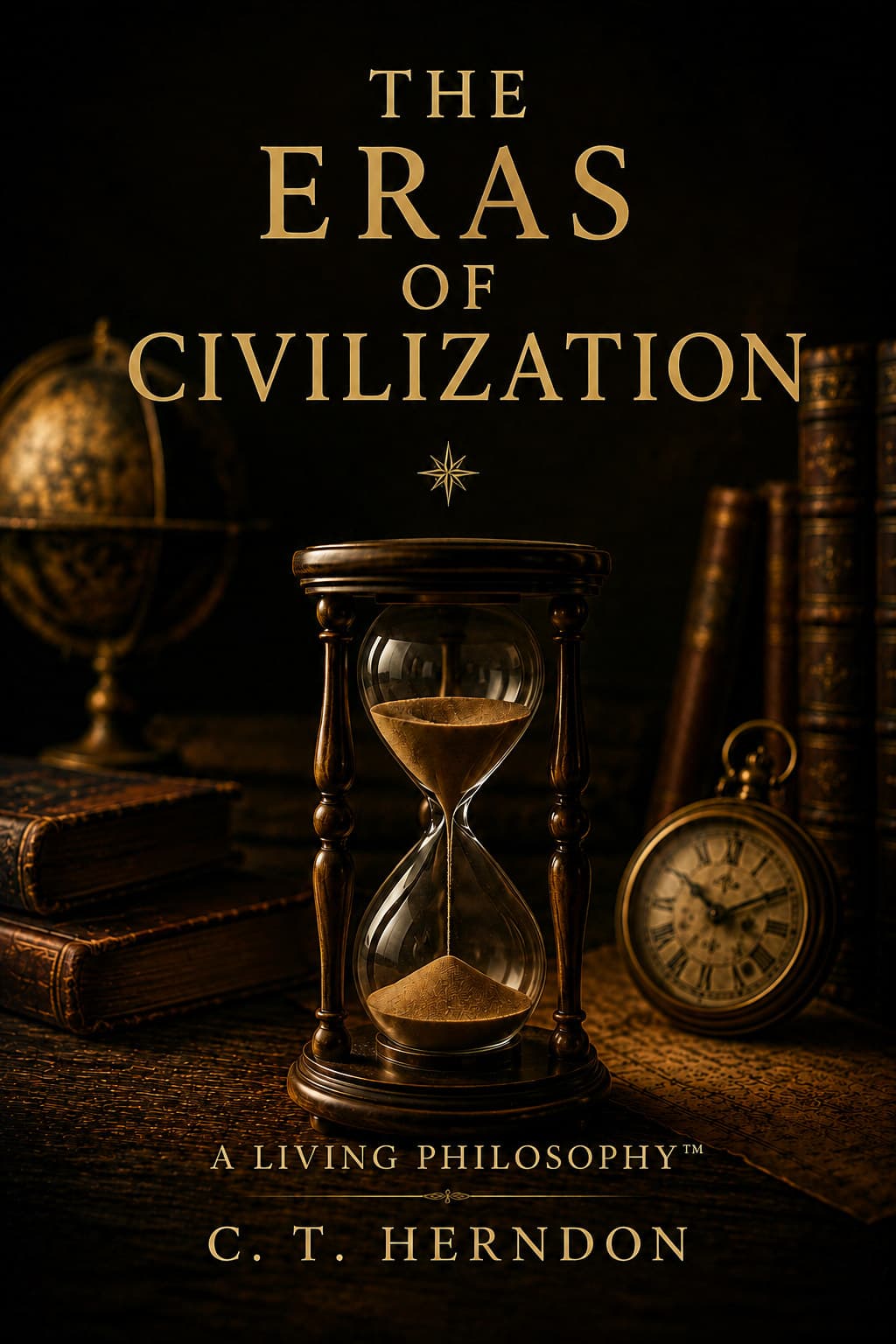
The Eras of Civilization
Book 9 · Time and the World · Eras
“On time, without cruelty.”
Four trilogies, twelve volumes, approximately one million words, complete. Each theme is carried from the self to the community to the world, and every volume can be read on its own.
The Eras of Civilization completes the Time Trilogy by extending the inquiry beyond the individual life and the institution into historical time itself.
Civilizations create clocks larger than clocks. Calendars, market hours, public rituals, transport systems, workweeks, legal deadlines, broadcast signals, infrastructures, seasons of obligation, and inherited narratives all teach populations how to move through time. These systems can coordinate millions of lives with extraordinary precision. They can also become cruel when the measure forgets the bodies, landscapes, histories, and differences it was created to serve.
The seven custodies return at the longest scale. Breath becomes the felt rhythm of a people. Attention becomes public priority. Pattern becomes civic habit and institutional arrangement. Margin becomes resilience within systems that cannot run forever at maximum load. Memory becomes history and archive. Threshold becomes era change. Bequest becomes what one age leaves to another.
The book treats historical reform with restraint. New temporal systems often bring wound and blessing together. The ethical question is not whether civilization should measure time but whether its measures remain proportionate, revisable, and merciful.
Its final movement also opens the next trilogy. After sands, clocks, and eras have done their work, a larger question remains: is there more than duration itself? The epilogue does not answer with doctrine. It answers with posture: attention, truthful speech, kept promises, quiet forgiveness, courage, belonging, and a willingness to recognize nearness without pretending to possess it.
The central idea
Civilizations keep time well when systems of measure remain answerable to bodies, seasons, memory, and the generations who inherit their consequences. Accuracy and tenderness are not rivals.
From the book
Verbatim“You rest your palm on wood and warmth answers without drama. Breath finds the pendulum and keeps it. Ribs and brass complete their circles together. The compass cools a sentence before it tries to perform. The bell remains unpulled, the most eloquent work it can do. The ledger leaves air around the name and room for an obligation that does not devour it. The card that reads begins holds the first square. The posted right to say not yet keeps appetite at a distance that lets thinking continue. Chronos speaks in a tone bodies can live with: one weight for market and dusk, one measure that refuses uniforms, one hour ferries, surgeons, ballots, cradles, and graves can share. Kairos answers from the hinge: open one minute when a face needs it, close one sentence early before policy turns to theater, grant a seventh syllable once in storm and retire it by morning. Between corridor and hinge, accuracy and tenderness cease pretending to be rivals.”
“You do not need a monument to finish. The room itself is the conclusion. The chair by the window keeps the shape of bodies that refused to perform patience. The cup stays filled because gathering begins with a throat. The compass teaches north the coolness of humility. The ledger holds names with air so journeys do not suffocate. The bell keeps one word for stewardship. The window remains at four fingers and lets weather participate in law. The two clocks continue their argument in a key that spares pride the need to be right. On time, without cruelty.”
“This is all we promised. This is all to keep.”
“One exact act now: before the light turns, walk to the nearest threshold under your care and remove the smallest tax that calls itself necessity; slide the bench a palm from the door so knees are not billed for arrival; raise one word on the nearest notice by a point so an elder can agree without borrowing eyes; open the window to four fingers so weather proofs your certainty; fill the cup and set it by the bell; then write the hour in a hand a stranger could trust and lower the latch as if returning a borrowed instrument, so the century beginning in someone else’s ribs will find your room already kind.”
The Eras of Civilization, Book IX
Place in the Time trilogy
Book IX completes the widening of the Time Trilogy and becomes a threshold into the Sacred Trilogy. The finite self, the organized institution, and the historical world have all been examined; what remains is the question of the “more” that may be encountered within and between them.