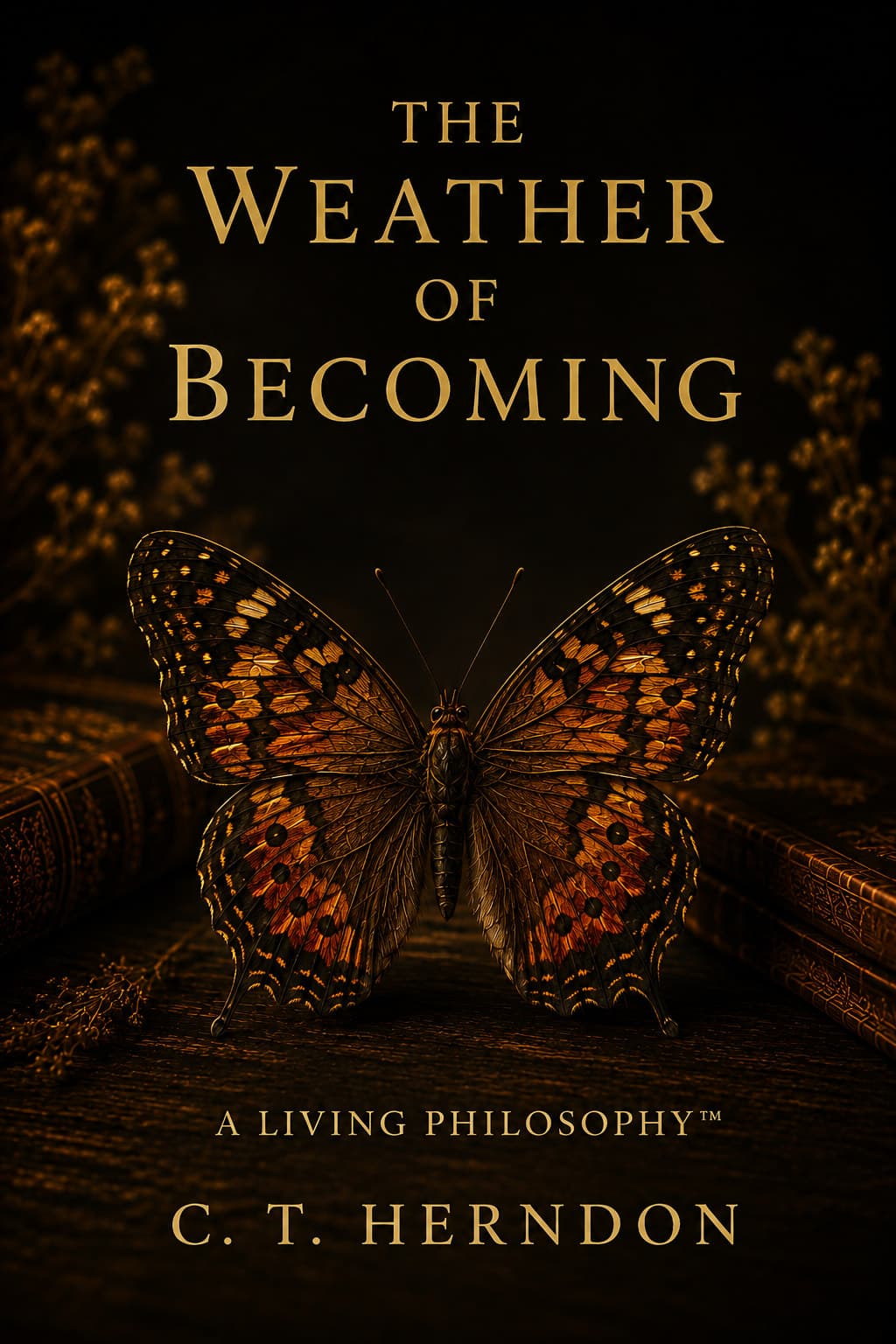
The Weather of Becoming
Book 6 · Transformation and the Civilization · Renaissance
“The civilization that forgets its bodies forgets itself.”
Four trilogies, twelve volumes, approximately one million words, complete. Each theme is carried from the self to the community to the world, and every volume can be read on its own.
The Weather of Becoming carries the transformation grammar to its widest scale: civilization.
The book does not imagine renaissance as a heroic reset, a leader’s achievement, or a clean historical break. Civilizations transform unevenly, through institutions, neighborhoods, infrastructures, public memory, habits, tools, and bodies that continue living while the larger order is changing around them. What looks like a period on a timeline is experienced as weather by those inside it.
The seven movements return once more. Fracture asks a civilization to name cracks before they become chasms. Grief asks it to carry losses without hardening into cynicism or escaping into denial. Silence restores weight to public language. Fire distinguishes transforming heat from destructive spectacle. Emergence shelters beginnings before they can be branded or consumed. Awkwardness protects the clumsy transition between old competence and new. Rhythm creates a tempo that many people and institutions can actually keep together.
The book continually grounds civilization in bodies and ordinary systems: stations, streets, courts, hospitals, ledgers, signals, public rooms, and the small acts through which trust becomes infrastructure. A civilization is not transformed because it announces a new era. It is transformed when its daily arrangements begin to carry different values reliably.
Renaissance, in this sense, is neither nostalgia nor novelty. It is the emergence of a more truthful form from a people willing to pass through the full weather of becoming.
The central idea
The scale grows and the grammar remains: see clearly, name honestly, grieve fully, tend the fire, shelter what emerges, befriend the awkward passage, and find a rhythm strong enough to carry many across.
From the book
Verbatim“The seven movements have done their work at the scale of civilizations. Fracture taught the civilization to name its cracks before they become chasms, to see the breaking as the beginning of something rather than only the end of something else. Grief taught the civilization to carry its losses without hardening into cynicism or softening into denial, to honor the dead without being captured by death. Silence taught the civilization to listen before it speaks, to let weight return to language that noise had made weightless. Fire taught the civilization to meet heat with craft rather than panic, to tend the flame that transforms rather than only flee the flame that destroys. Emergence taught the civilization to shelter beginnings until they can stand, to recognize the new life when it appears rather than demanding it appear on schedule. Awkwardness taught the civilization to befriend the clumsiness that marks the passage between competencies, to protect the stumbling that growth requires. Rhythm taught the civilization to keep a beat strong enough to hold its people through weather, to find the tempo that many can keep together.”
“Each movement returned to the body, because the body is where civilizational life is actually lived. The policies are abstractions until bodies implement them. The values are words until bodies embody them. The rhythms are patterns until bodies keep them. This is not reduction but grounding. The civilization that forgets its bodies forgets itself, and the forgetting shows in everything from the design of its spaces to the pace of its decisions to the quality of its care. The trilogy has insisted on the body at every scale because every scale ultimately returns to bodies breathing, moving, deciding, hoping, grieving, celebrating, resting, working, dying, and being born.”
“This was the work of transformation at civilizational scale. Book Four asked what happens when a single self consents to cross the threshold of renewal. Book Five asked what happens when an institution crosses together. This book has asked what happens when a civilization undertakes the same passage. The questions are related but not identical. A self can transform in solitude. An institution cannot transform without its members. A civilization cannot transform without its institutions, its peoples, its lands, its memory, its hope. The scale grows and the grammar remains: see clearly, name honestly, grieve fully, tend the fire, shelter what emerges, befriend the awkward passage, and find a rhythm strong enough to carry many across.”
The Weather of Becoming, Book VI
Place in the Transformation trilogy
Book VI completes the trilogy by showing that civilization does not transform apart from selves and institutions but through them. The arc is extension rather than disappearance: the personal, institutional, and civilizational scales remain distinct while participating in the same living passage.