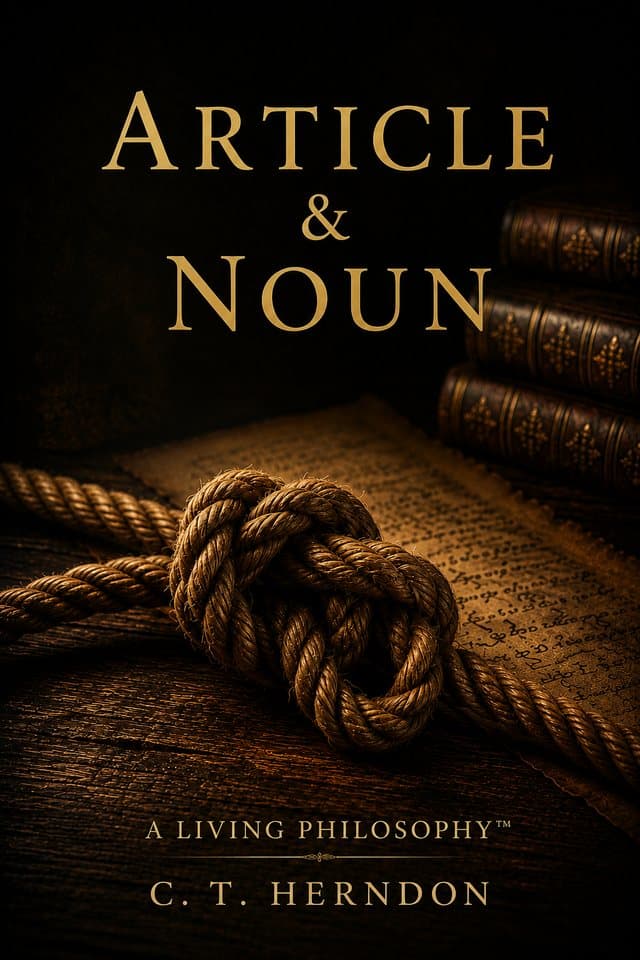
Article and Noun
Book 13 · Attention and Being · The Grammar of God Trilogy
“A stone teaches that existence is not an argument. Being does not apologize for remaining.”
Written, not yet published. All fifteen books are finished; none has been published. The first volume, Echoes of the Unseen, will be published in 2026. A date has not been set.
Article & Noun opens the final trilogy by returning philosophy to the first moment of encounter: before we act on the world, do we actually see what is there?
The book treats grammar as moral posture rather than linguistic classification. The article becomes attention, the small word that points, distinguishes, and says here. The noun becomes being, the weight of the thing that exists before the observer uses it, explains it, improves it, or turns it into symbol.
The lamp and the stone become the book’s primary instruments. The lamp teaches a form of attention that illuminates without becoming the subject. The stone teaches the stubborn dignity of existence: matter does not need permission from the observer to be real. From these objects the book develops an ethics of naming. A name can clarify, but it can also flatten. To name responsibly, attention must be held at a respectful distance long enough for reality to resist projection.
The book moves through The Lamp and the Eye, The Threshold of Naming, The Weight of the Stone, and The Keeper and the Kept. Its room is populated by pages, basins, bells, hands, materials, and trades because the Grammar insists that abstract thought remain answerable to things that have weight, texture, limits, and histories.
The first lesson of the Grammar is therefore humility: attention first, being second, naming only after contact. Before the verb changes anything, the noun must be allowed to stand.
The central idea
Attention is the first kindness; being must be allowed its gravity before we use, change, or name it. The Grammar begins by teaching the observer to see without devouring what is seen.
From the book
Verbatim“There is a stone on the table as well, palm-sized, river-worn, the kind a child pockets without explanation. Its weight is honest. When you set your hand over it the skin finds both cool and warmth, the cool of matter that refuses to hurry, the warmth your body lends to what it chooses to keep. A stone teaches that existence is not an argument. Being does not apologize for remaining. You turn it once, feel the smoothness in one arc and the rough seam along the other, and something inside your chest steadies as if gravity were an interior language you had briefly forgotten how to speak.”
“The first naming does not begin with speech. It begins with looking until the object begins to look back. Attention is not a spotlight thrown at the world; it is a lamp held at a respectful distance. To attend is to say, without sound, I will not devour you with my need to define. I will let you be, and in that letting, I will learn what you already are. The dust in the beam nods as if to agree. The page does not rush you. The bell waits, metal and patience, its voice folded inside shape.”
“You breathe. The basin answers with the smallest tremor, not a ripple you can see, only the way a reflection wavers when breath arrives near water. You watch the wavering settle. You notice that silence is not the absence of sound but the presence of proportion. When air, light, and matter hold one another in right relation, the room feels true. This is the beginning of awe. Not spectacle. Not overwhelm. The holiness of exactness. The fit of a lid on a jar. The weight of a simple stone that asks nothing except to be what it is.”
“You let your fingertips rest on the page. Paper was once fiber taken from plant and patient water. Someone lifted the pulp with a screen and let it drain until the sheet held together. Someone pressed it. Someone dried it. Someone cut it clean. You can feel the history of that labor in the tooth against your skin. To write here would be to join a lineage of hands that believed matter could carry meaning without breaking. That belief is a vow. Even before ink, the page is a covenant, a field cleared for the seed of a word.”
“The lamp gives the room a center without demanding that everything revolve around it. You can stand anywhere and still see. Light does not insist on being the subject. It makes other things visible and feels content. When it touches the stone, the stone does not glow. It simply shows more of its truth. You see the faint bruise of iron near one edge. You see a shallow notch where another stone struck it in water years ago. To name this would be to honor those facts as facts. You do not need to call it significant. You need only call it by what it is, and even that calling must be done with tenderness. If a name is a tool, it must be sharpened to cut away your projections, not the thing itself.”
— Article and Noun, Book XIII
Place in the Grammar of God trilogy
Book XIII lays the floor on which the final trilogy stands. It establishes the ethical order of attention and being so that later action, description, relation, covenant, and ritual remain answerable to reality rather than projection.