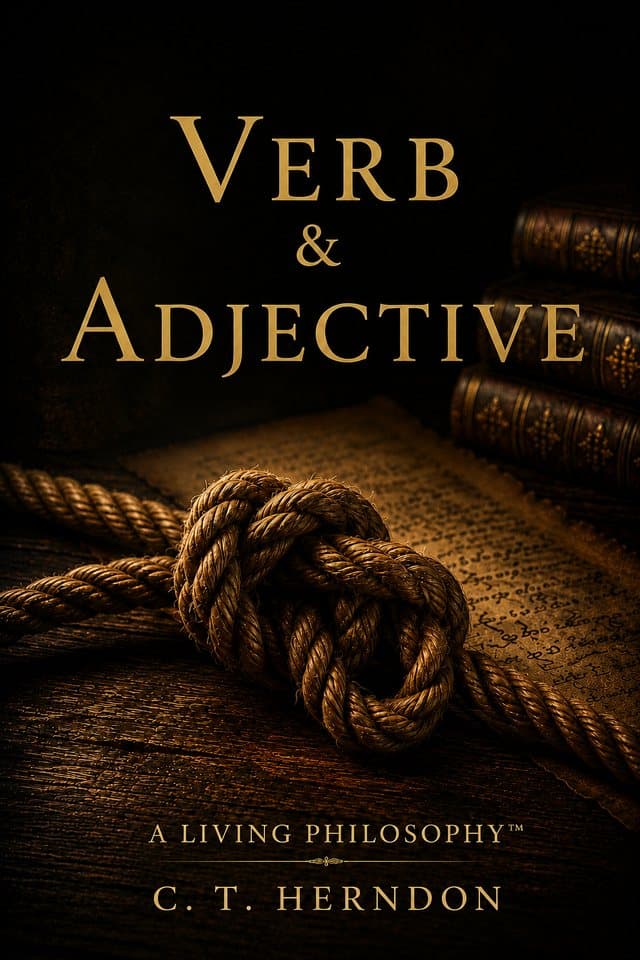
Verb and Adjective
Book 14 · Becoming and Proportion · The Grammar of God Trilogy
“The verb is not an action. The verb is a promise.”
Written, not yet published. All fifteen books are finished; none has been published. The first volume, Echoes of the Unseen, will be published in 2026. A date has not been set.
Verb & Adjective begins where Article & Noun had to stop. Once being has been attended to and named with care, something acts.
The book’s first great claim is that the verb is not merely action; the verb is vow. Every meaningful act commits the actor to consequence. The smith’s hammer changes iron. The gardener’s hand changes a living system. Ink changes a page. Action enters the world and cannot be treated as though it leaves no remainder. Becoming is therefore not chaos. It is direction, and ethical becoming is faithfulness to the form the action claims to serve.
The adjective introduces the counterweight of proportion. Description is never neutral when it determines how a thing will be valued, treated, measured, or remembered. Proportion asks whether the words and measures applied to reality preserve its dignity or reduce it to appetite. The book repeatedly resists the seduction of numbers or adjectives that are technically accurate but morally incomplete.
The later movement toward the architecture of between makes relation itself visible. A stone on a table is not merely two nouns. The on matters. The bridge matters. The between is full. Relationship turns isolated things into participants in a larger structure without requiring either to lose identity.
The book thus joins motion to restraint: become, but faithfully; describe, but proportionately; relate, but without possession. Action becomes ethical when the vow, the measure, and the between remain intact.
The central idea
Becoming is faithful action, and proportion is the mercy that keeps action and description from becoming excess. The verb changes the world; the adjective and the architecture of between require that change to remain answerable to what the world actually is.
From the book
Verbatim“The verb is not an action. The verb is a promise. This is the sentence the room has been building toward since the forge lit in the square, since the hammer fell for the first time and the iron bent and the bending was permanent and the permanence entered the Grammar through the gap in the window and settled on the table beside the stone and the page and the lamp like a new weight the table had not been asked to hold.”
“The verb is a promise because every verb commits the actor to a consequence. The hammer falls and the iron bends and the smith is now the maker of a bend he cannot unmake. The shears close and the branch falls and the gardener is now the author of a separation he cannot undo. The pen touches the page and the ink flows and the writer is now the keeper of a sentence he cannot unwrite. Every verb is a marriage to a result. Every verb is a vow spoken not in words but in the body’s commitment to a direction, the hand’s commitment to a force, the will’s commitment to a change that will outlast the moment of the changing and enter the world as a fact the actor must live with.”
“You know this from the garden. You have always known this from the garden, though you did not have the word for it until the Grammar gave you the word, until the forge gave you the sound, until the hammer gave you the rhythm in which the word could be heard. You know that the seed placed in the soil is a vow. The seed says: I will become. The hand that places the seed says: I will tend what becomes. The soil that receives the seed says: I will hold what is tended. The water that reaches the seed says: I will carry what the soil holds. The chain of vows extends from the hand to the soil to the water to the root to the stem to the leaf to the flower to the fruit to the seed again, and every link in the chain is a verb, and every verb is a promise, and every promise is kept or broken, and the keeping or breaking determines whether the chain continues or ends.”
— Verb and Adjective, Book XIV
Place in the Grammar of God trilogy
Book XIV makes the Grammar dynamic. The being established in Book XIII now acts, changes, describes, measures, and enters relation. This prepares Book XV, where relationships must become covenants capable of surviving difference, loss, exception, and time.