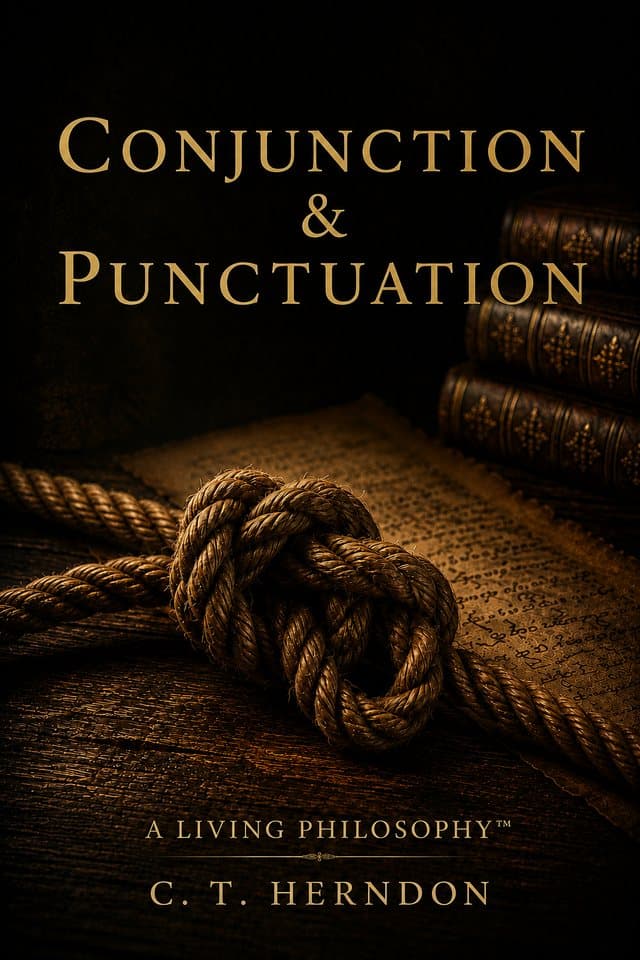
Conjunction and Punctuation
Book 15 · Covenant and Ritual · The Grammar of God Trilogy
“The Grammar does not close. The practice does not end. The room continues.”
Written, not yet published. All fifteen books are finished; none has been published. The first volume, Echoes of the Unseen, will be published in 2026. A date has not been set.
Conjunction & Punctuation completes The Resonance Canon by asking what holds after the parts have learned to stand, act, and relate.
Its central object is a cord carrying seven knots. Each knot becomes a conjunction: AND, BUT, OR, BECAUSE, ALTHOUGH, IF, and AND THEN. These are not treated as technical parts of speech. They are moral forms of binding. AND joins. BUT preserves the truth of exception and contradiction. OR names genuine alternatives. BECAUSE carries reason and responsibility. ALTHOUGH holds continuity across difficulty. IF opens the conditional future. AND THEN becomes the grammar of inheritance, the promise that completion can be followed by another beginning.
Punctuation brings another necessity: a living grammar must know when to pause and when to stop. The death of the elder makes the period more than a mark on a page. Completion is real. Grief cannot be edited into a comma simply because the room wants continuation. Yet the period is not the end of Grammar itself. Another sentence can begin.
Ritual is where this grammar becomes embodied. Cord, stone, lamp, bell, basin, bread, hinge, chair, bench, and repeated practices teach the hands what theory alone cannot carry. The book insists on an order: doing first, naming after; practice first, understanding after.
The Canon therefore closes by refusing closure. The room has a door. The practice continues through other hands. The final authority is not the book but the living grammar of service, covenant, attention, and faithful continuation.
The central idea
Covenant is the grammar that binds difference without erasing it, and ritual is the punctuation that lets a living sentence join, qualify, mourn, end, and begin again. The practice is the point.
From the book
Verbatim“The Grammar is not a book. The Grammar is a room.”
“A book closes. A book has a first page and a last page and the pages between them contain the book’s meaning and the meaning is bounded by the covers and the covers say: the meaning begins here and the meaning ends here and the ending is the book’s completion, the book’s period, the book’s final sentence followed by the silence of the closed cover.”
“A room does not close. A room has walls and a floor and a ceiling and a door and the door can be opened and the opening lets the room continue into the hallway and the hallway continue into the stairs and the stairs continue into the square and the square continue into the town and the town continue into the world and the continuing is the room’s nature, the room’s grammar, the room’s refusal to be bounded by the walls that hold it.”
“The Grammar is a room. The Grammar has walls. The Grammar has the stone and the cord and the page and the lamp and the bell and the basin and the hinge and the bread and all the objects that hold the Grammar’s meaning in the Grammar’s space. But the Grammar has a door. And the door is open. And the opening lets the Grammar continue past the walls into the practice the walls contain but do not confine, the practice that enters the room when the trades climb the stairs and that leaves the room when the trades descend the stairs, the practice that lives in the room and in the square and in the harbor and in the forge and in the shop and in the kitchen and in the field and in every place the hands perform the verbs the Grammar has been learning to name.”
“The Grammar does not close because the practice does not close. The practice does not close because the morning comes and the morning requires the practice and the practice requires the morning and the two requirements hold each other the way the hemp and the cotton hold each other in the wrapping the gardener tied on the first morning of the cord’s teaching, by the contact, by the friction, by the holding that does not end because the held things have not been released.”
“You sat in the room and you held the cord and you did not try to understand the cord.”
“You did not try to understand the cord because the cord does not ask to be understood. The cord asks to be held. The stone does not ask to be understood. The stone asks to be held. The lamp does not ask to be understood. The lamp asks to be filled. The bell does not ask to be understood. The bell asks to be rung. The basin does not ask to be understood. The basin asks to be filled. The objects do not ask for the mind’s comprehension. The objects ask for the hand’s participation. The objects ask for the practice.”
“The seven knots are not a philosophy. The seven knots are a practice. The seven conjunctions are not a theory of language. The seven conjunctions are the names the room gave to the bindings the room was already performing before the bindings had names. The room was performing the AND before the room called it the AND. The shoemaker was pulling the chair before the pulling was named covenant. The baker was tearing the bread before the tearing was named offering. The elder was closing his eyes before the closing was named listening. The names came after the practice. The understanding came after the doing. The Grammar came after the room.”
“This is the order. This is the only order the Grammar recognizes. The doing first. The naming after. The practice first. The understanding after. The hand first. The mind after. The room does not begin with the theory and proceed to the practice. The room begins with the practice and the practice produces the understanding and the understanding is not the point. The practice is the point. The understanding is the residue the practice leaves in the mind the way the warmth is the residue the gathering leaves in the bead, real, present, valuable, but not the purpose.”
“The purpose is the holding. The purpose is the filling. The purpose is the ringing. The purpose is the tearing. The purpose is the climbing. The purpose is the sitting. The purpose is the closing and the opening and the listening and the stitching and the tying and the dipping and the striking and the mapping and the walking and the returning and the continuing. The purpose is the verb. The purpose is always the verb.”
“The Grammar does not close because the verb does not close. The verb continues. The lamp is filled and the lamp burns and the lamp is filled again. The bread is baked and the bread is eaten and the bread is baked again. The net is tied and the net tears and the net is mended. The stitch is placed and the stitch holds and the stitch is placed again. The verb continues. The AND THEN continues. The practice continues.”
— Conjunction and Punctuation, Book XV
Place in the Grammar of God trilogy
Book XV is both culmination and handoff. It binds the Grammar’s earlier elements into covenant, teaches the necessity of endings and exceptions, and then places continuation in the hands of those who come after. The Canon ends not with possession but with an open door.