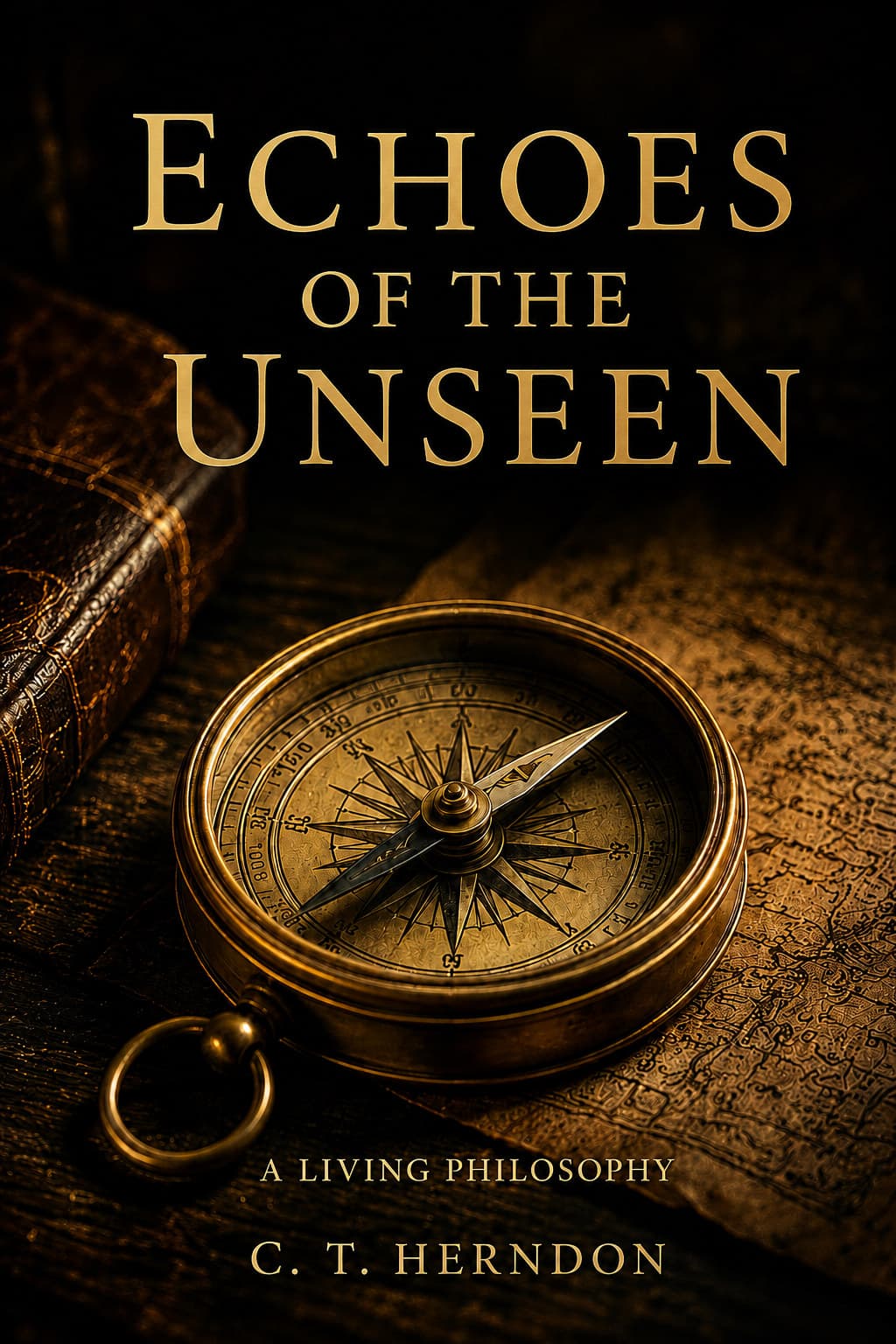
Echoes of the Unseen
Book 1 · Resonance and the Self · Tuning
“Authenticity is alignment between inner and outer.”
Four trilogies, twelve volumes, approximately one million words, complete. Each theme is carried from the self to the community to the world, and every volume can be read on its own.
Echoes of the Unseen begins the Resonance series with a proposition that will govern everything that follows: leadership starts before the first word is spoken.
Rooms respond to coherence and contradiction, steadiness and anxiety, attention and absence. People register whether words and actions agree, whether promises have accumulated weight, whether another person is genuinely listening, and whether authority is grounded in something deeper than performance. The book calls this underlying field resonance.
Its first instrument is a two-note compass: authenticity and resilience. Authenticity aligns inner and outer life; resilience preserves that alignment through pressure, disturbance, and time. From that compass the book develops a sequence of movements: promises, listening, questions, humility, vision, trust, courage, adaptability, and wisdom. No movement is sufficient by itself. Each corrects and completes the others.
Throughout the book, science, philosophy, myth, and history are braided together, then returned to ordinary practice through anchors and case studies. The result is neither a list of leadership techniques nor an argument for charisma. It is an inquiry into how a human being becomes trustworthy enough that presence itself begins to alter what is possible around them.
By its close, the compass is placed beneath a North Star: a moral orientation that does not move with applause, urgency, title, or circumstance. The unseen becomes audible when a person repeatedly aligns character, action, and purpose until others can feel the difference.
The central idea
Leadership is resonance made responsible. Leadership is not the performance of isolated virtues. It is the responsible integration of them into a coherent life. Authenticity without resilience fails under pressure; courage without wisdom becomes recklessness; adaptability without fidelity becomes opportunism. The task is to bring the whole instrument into tune.
From the book
Verbatim“Leadership is not a list, not a pocket of skills to be checked and shelved, not a performance that dazzles for a season and fades. Leadership is resonance. It is the music that happens when many movements sound together, when a whole life meets a whole people and the unseen becomes audible. We began with a compass, authenticity and resilience set like true north and steady bearing. We walked nine movements, each a note that matters, none sufficient alone, all necessary together. Now the music must gather, not as summary, but as chord.”
“Here is the plain claim: leadership is resonance made responsible.”
“A promise apart from listening grows brittle and hardens into contract that forgets covenant. Listening without questions turns to a silent room where truth is never invited to speak. Questions without humility collapse into display, curiosity performed rather than lived. Humility without vision bows and bows yet does not rise to lead. Vision without trust becomes projection, a bright image that will not bear weight. Trust without courage remains fragile and unproved. Courage without adaptability runs forward on shifting ground and calls it victory. Adaptability without wisdom dissolves into opportunism, form changing while essence is lost. Wisdom without authenticity curdles into manipulation, cleverness of control that unravels a soul. Each movement needs the others the way a violin needs breath in the hall, the way a drum asks for strings to answer, the way every instrument seeks a tuning note before the first bar.”
Echoes of the Unseen, Book I
Place in the Tuning trilogy
Book I provides the tuning without which the rest of the trilogy cannot occur. It establishes the compass, the North Star, the language of resonance, and the fundamental movements that will later be translated from individual character into communal culture and finally into civilizational stewardship. The journey begins with the self not because the self is the destination, but because every larger field will inherit what the self brings into it.