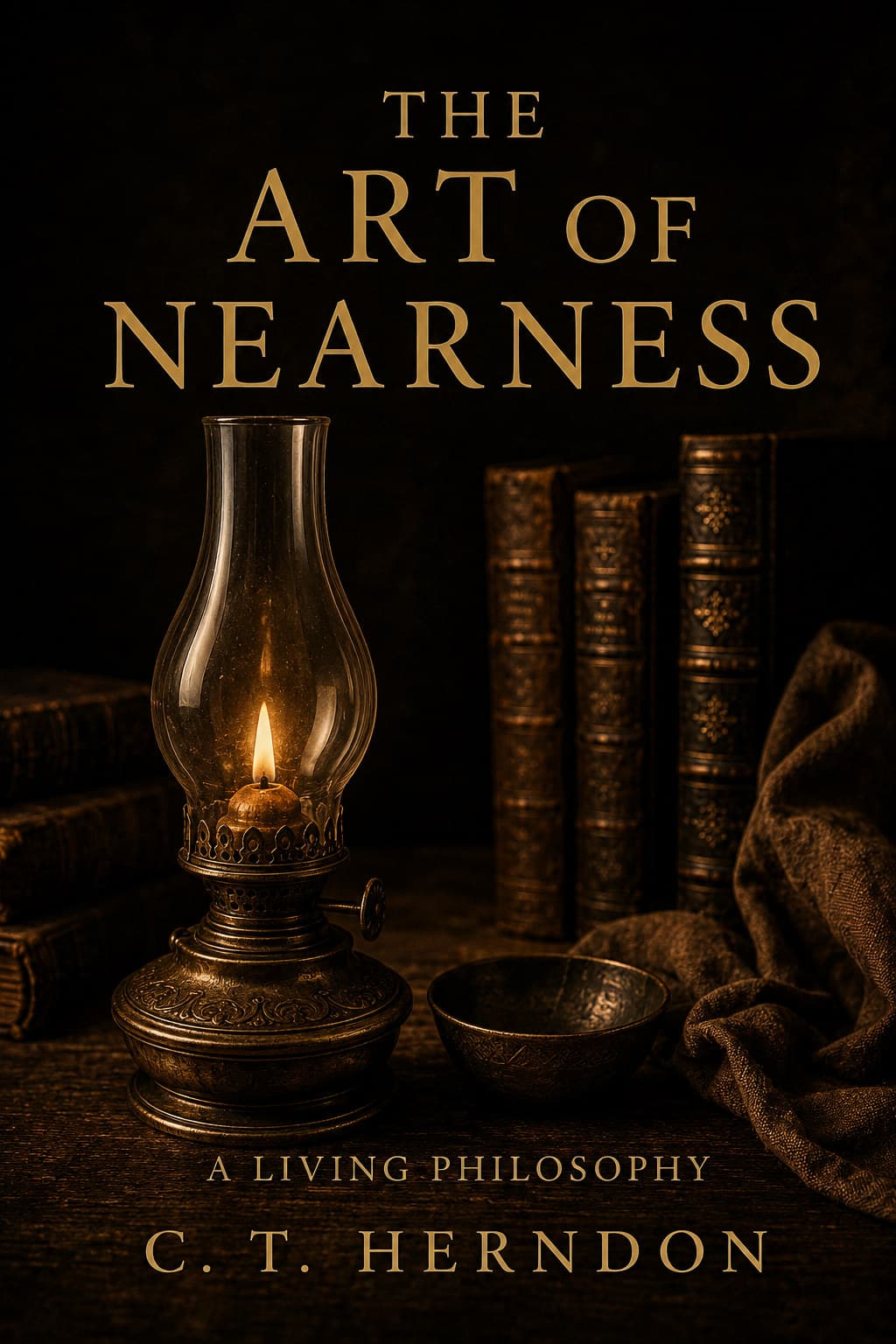
The Art of Nearness
Book 10 · The Sacred and the Self · Breath
“The sacred enters through maintenance.”
Four trilogies, twelve volumes, approximately one million words, complete. Each theme is carried from the self to the community to the world, and every volume can be read on its own.
The Art of Nearness opens the Sacred Trilogy by refusing the assumption that the sacred must be distant, spectacular, or inaccessible.
Its scale is the self, and its first instrument is breath. Before architecture, doctrine, or ritual, there is the body receiving and releasing air. From that intimate measure the book moves through seven chapters: The Held Breath, Ache, Mercy, Silence, Fire, Ash, and Light. Each explores a different way human beings encounter what exceeds control without needing to escape the ordinary world.
Ache is not treated as a problem to be erased but as evidence of relation and longing. Mercy is the discipline that prevents truth and power from becoming cruel. Silence gives reality room to arrive without being immediately consumed by explanation. Fire carries both transformation and danger. Ash remembers what burning cost. Light becomes illumination only when it reveals without overwhelming what it touches.
The book continually locates the sacred in maintenance and proportion: a lamp positioned so faces can be seen rather than interrogated, a breath that steadies a room, a craft performed accurately, a window, a bowl, a hand, a pause. Awe is not dependent on scale. It can arise from the exactness with which ordinary matter is tended.
The sacred self is therefore not a person who possesses certainty. It is a person learning the art of remaining near, to body, reality, suffering, beauty, and the unclaimed depth that can become visible when attention is patient enough to receive it.
The central idea
The sacred begins not in distance or spectacle but in nearness. Breath, ache, mercy, silence, fire, ash, and light become practices through which ordinary life is encountered with enough attention and proportion to reveal more than utility alone can see.
From the book
Verbatim“Outside, the city wakens in deliberate increments. Brooms converse with cobblestone; kettles exhale; bells share distances from tower to tower. Every tone knows its place. The sacred, it turns out, never required silence, only measure. When motion and stillness strike their chord in right proportion, a third sound appears, the resonance of a world reconciled to itself. That is the timbre of understanding. It cannot be forced; it must be heard through care.”
“Breath is the first and last instrument of that harmony. Before architecture, before scripture, came exhalation. The universe began as pressure released into emptiness, a syllable so vast we are still hearing its echo. Each nebula extends that original sigh. To breathe now is to join the oldest creative act: to give form without conquest, to fill space without ownership. Light only completes what breath begins. One moves through air, the other through duration; together they script the grammar of existence. The wise learn to read without rushing, each inhale a word, each exhale a translation.”
“Across centuries, civilizations tried to imprison this truth in monument. They built pyramids to preserve breath, cathedrals to shelter light. Yet both persist only through hands that sweep and polish. Continuance is never marble or window; it is the gesture that keeps them legible. The sacred enters through maintenance. A world that stops cleaning its lenses forgets how to see. A leader who stops tending the room forgets that brilliance is borrowed.”
“In the workshop beside the river, the furnace rests, but warmth still hums in the bricks. Tools hang clean, their shadows forming a second architecture against the wall. On the bench sits a single bowl of clear glass holding nothing but morning. Whoever stands there next will see their reflection curve across its surface and understand that this, finally, was the book’s subject: illumination as witness, craft as prayer, the everyday reimagined as vessel for awe.”
The Art of Nearness, Book X
Place in the Sacred trilogy
Book X grounds the Sacred Trilogy in the body before the inquiry widens to community and world. Breath establishes the measure: the sacred must be inhabitable at human scale before it can be shared or transmitted.