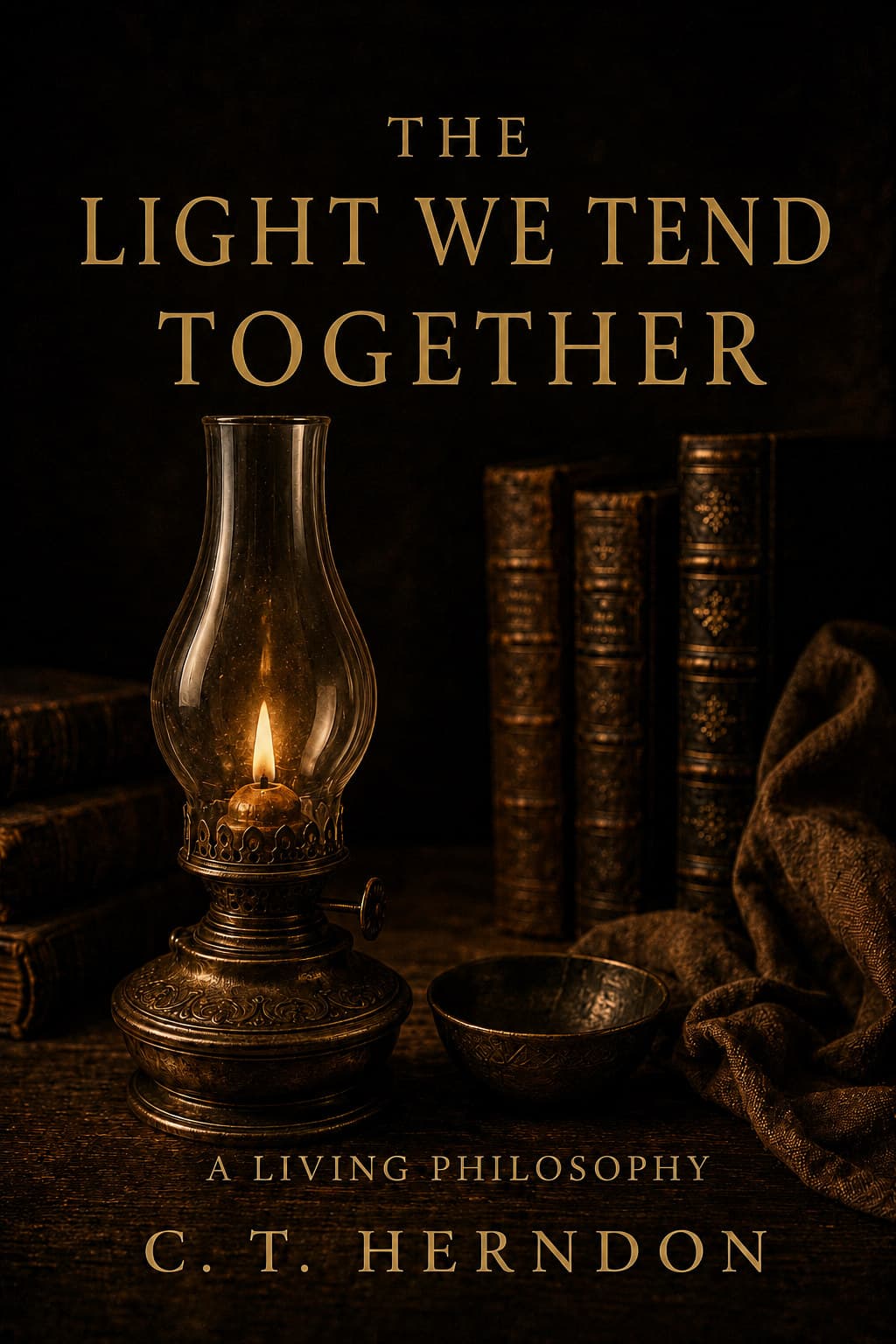
The Light We Tend Together
Book 11 · The Sacred and the Community · Fire
“Whatever is lit must also be tended.”
Four trilogies, twelve volumes, approximately one million words, complete. Each theme is carried from the self to the community to the world, and every volume can be read on its own.
The Light We Tend Together asks what happens when the sacred is no longer a private encounter but a shared responsibility.
Its governing image is fire. Human community has always gathered around flames because fire makes relation visible: it warms, feeds, illuminates, gathers, and protects, but the same force can consume what it was meant to serve. The ethical task is therefore not simply to keep the fire burning. It is to tend its temperature.
The book develops that task through Kindling, Circle, Vigil, Feast, Ashes, and Hearth. Kindling asks how shared meaning begins. Circle explores the form that allows many bodies to gather without losing one another. Vigil examines the disciplined attention required to keep watch through uncertainty. Feast treats abundance and celebration as communal acts that require proportion. Ashes asks how communities remember damage and loss without turning memory into either spectacle or denial. Hearth gathers the movements into a durable center of warmth, belonging, and return.
The book’s sacred community is not defined by uniform belief. It is defined by how people tend what they share. Ritual, hospitality, memory, repair, food, light, architecture, vigilance, and care become the practical vessels through which a community makes room for one another.
The result is a philosophy of shared fire: enough warmth to gather, enough restraint not to consume, enough memory to honor the ashes, and enough continuity that another person can find the hearth when they arrive in the dark.
The central idea
A community becomes sacred when it learns to tend shared fire, kindling meaning, making a circle, keeping vigil, receiving abundance, carrying ashes, and maintaining a hearth whose warmth is available without becoming destructive.
From the book
Verbatim“When the age of fire first began, the story was simple. A spark struck flint, breath met tinder, and the dark receded. Everything after that has been commentary, our long attempt to live with what we lit. The first hearth burned in a circle of stone, its warmth shared by bodies pressed close, faces made visible by risk. That circle became the earliest room, and rooms became the first pattern of civilization. Even now, every city is a memory of that moment: the attempt to keep the night away without losing what the night teaches.”
“Fire always had two tempers. It could cook or consume, heal or reveal too much. We built chimneys to train its ascent, glass to filter its light, law to discipline its reach. The story of every people is written in how they housed their flames. Some raised towers that glared against heaven, some learned to build lamps that listened to the hour. The wise discovered that brightness without proportion is another form of blindness. The foolish burned what they wanted to see.”
“When the great fires of industry came, we mistook illumination for power. We filled nights with noise, lit every corner, and forgot that light itself can tire. But slowly, as cities began to choke on their own glare, a quieter understanding returned. Architects began to measure light not only by watt but by warmth, by how a window might let dusk breathe, by how a lamp could give one face its proper dignity. Energy became ethics again. We learned that civilization endures not by banishing darkness but by making it bearable.”
“A bell sounds from the river quarter, where bridges rise like ribs of a living body. Its tone travels across the glass of high towers, through air cooled by water, over streets that shine not with fluorescence but with the sheen of rain. The city has found a temperature. Through a single window near the upper floors, a hand moves across a page. The reader is not studying doctrine; the reader is keeping rhythm, tracing sentences that hum with the pulse of the rebuilt world. The breath that lifts the curtain is the same breath that once bent flame toward bread. The continuity is exact.”
“In the lower streets, a lamp above a door marks the threshold of a café that opened after the last quake, when the city first dared to laugh again. Its glass is imperfect, slightly bubbled, so the light wavers on the stone like water. Inside, the walls are lined with reclaimed wood, burn marks still visible as thin black signatures. The owner left them on purpose, proof that damage and beauty are siblings. People sit in that room without guarding themselves. They talk across tables that remember ash. The air hums at the register of belonging. No one notices, but this is the true architecture of law, the calibration of warmth so that the visible does no harm.”
“Every civilization must decide how it will carry its fire forward. The law is simple, though costly: whatever is lit must also be tended. To keep flame is to inherit discipline. It is to accept that care will always outlive glamour. The finest streetlights in this city are those that turn themselves down near midnight, leaving just enough glow for the handrail of the bridge, the curve of the path, the sound of water below. They remind us that stewardship is not the act of keeping everything bright, but the art of letting the world sleep safely.”
The Light We Tend Together, Book XI
Place in the Sacred trilogy
Book XI turns the nearness of Book X outward. Breath becomes shared fire, and private attention becomes communal custody. It prepares the final sacred movement by showing that illumination worth carrying into the world must first learn mercy in the circle of community.