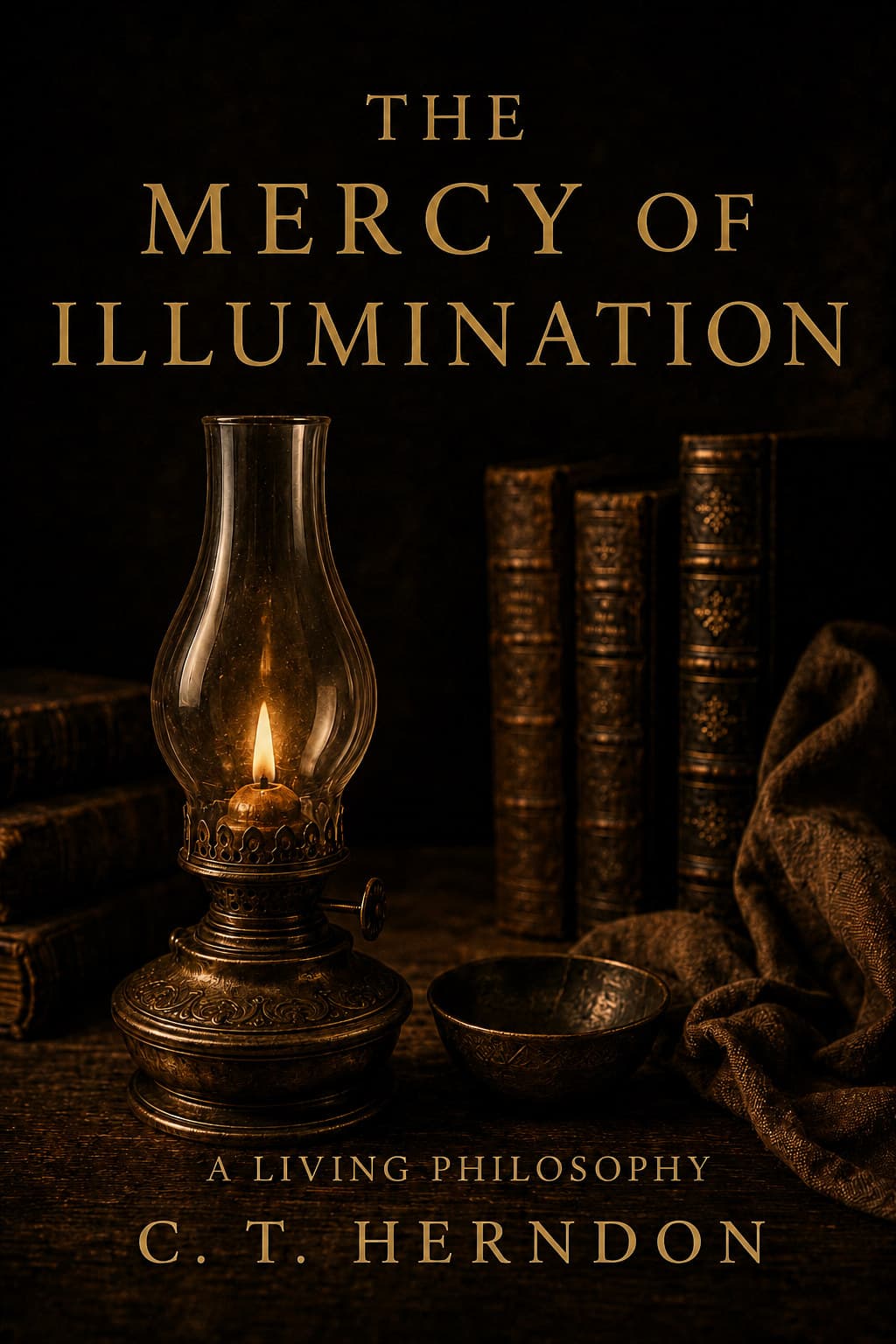
The Mercy of Illumination
Book 12 · The Sacred and the World · Light
“Completion is not the absence of flaw. Completion is the presence of care.”
Four trilogies, twelve volumes, approximately one million words, complete. Each theme is carried from the self to the community to the world, and every volume can be read on its own.
The Mercy of Illumination completes the Sacred Trilogy at the scale of the world.
If Book X began with breath and Book XI gathered around fire, Book XII asks what happens when light travels. Illumination can guide, reveal, connect, and make the world legible. It can also become glare, surveillance, spectacle, domination, or the conceit that seeing is the same as possessing. The governing question is therefore not how to make everything brighter, but how to make seeing merciful.
The book moves through Cathedral, Lens, Reflection, and Star. Cathedral asks how spaces can hold meaning larger than any single occupant. Lens explores the discipline of focus and the responsibility that comes with framing what others will see. Reflection asks how truth can be returned without distortion or exaggeration. Star becomes orientation: a light that guides precisely because it cannot be owned.
Throughout, craft and maintenance remain essential. Glass must be cleaned. Lamps must be tended. A lens must be aligned. A bridge light exists for the traveler rather than for its own display. Illumination becomes ethical when its reach carries rather than consumes.
The trilogy closes with a society of lights that do not outshine one another. Breath has become fire; fire has become light; light has learned proportion. The sacred is no longer an isolated experience but a way of arranging visibility, guidance, inheritance, and welcome so that strangers can find their way without being forced into another person’s glare.
The central idea
Illumination becomes mercy when light reveals without dominating. The sacred reaches the world when clarity learns proportion, guidance refuses possession, and human reach becomes useful to lives beyond the reacher.
From the book
Verbatim“Light draws itself nearer as if to confer. The room answers with the small adjustments companionship teaches: the chair angles a finger’s width toward the page; the hand hovers in readiness; the mirror keeps its silver without insisting. Within this arrangement the trilogy gathers under the skin of the moment. First movement: a life aligned by fidelity as a lens must be set to find focus. Second: a community inheriting steadiness and turning it outward, a shared clarity that keeps neighbors from losing their way. Third: that clarity sent traveling until it behaves like a constellation, points held in relation by trust, not force. He feels these three laws seated with him, one on either side, one in the light, and knows the book can close because the work proceeds.”
“The window squares a portion of night. In that square a star brightens above the bridge, distinguished by timing, not magnitude. It appears the instant the city needs a point to test its geometry. The bridge consents in rhythm; lamps along the span echo the star’s interval. Street by street the consent spreads. There is no command, only relief when things agree to keep relation. He writes a line to honor the exchange and lets the graphite cool: the highest light is the one that persuades others to shine with it.”
“The bell’s curve takes a seam of radiance and returns it as a slender line along bronze. It crawls toward the lip and gathers into a bright letter ready to be written. He does not touch the bell. He watches until the line thins and disappears. Reflection has completed its sentence. Not every instrument must sound to contribute; some keep truth by staying exact. Earlier books asked for courage; this last asks for proportion. Without proportion even courage confuses. The mirror confirms with its faithful refusal to exaggerate; it gives back the room as the room, not a theater of wishes.”
“He opens to a page from months ago. The handwriting then was narrow, strained with problem and proof. Tonight the script widens. Letters breathe in ink. He traces the change with one fingertip and lets the page fall. The curve is the record of attention over time. Leadership first arranges. Later it waits. Finally it welcomes. The trilogy has traveled that arc. He permits himself one pulse of tenderness for the labor and releases it. Sentiment belongs to the worker; steadiness belongs to the work.”
“Across the water a small boat moves under the bridge, running lights mirrored twice, once on the surface, once in the window. Four beacons where two exist, a doubling of doubling that turns transit into quiet procession. He imagines the pilot scanning for signs. They will never see this room, yet the room sees them. The coda must serve at that distance. It must return the world to itself with clarity a stranger can use. He writes a line meant for the first landing eye: leave one thing shining for a stranger you will never meet.”
“The cloth accepts his palm. Its threads have memorized the seasons here. Faint traces of soot remain, not a stain, a record. He does not scour them out. The Canon would fail if it closed without admitting how labor marks its instruments. Glass gains scrim of hairline scratches; metal dulls and brightens; pages show indentations from the sentences erased for better ones. At the city’s edge scaffolds learn the same lesson. Completion is not the absence of flaw. Completion is the presence of care.”
The Mercy of Illumination, Book XII
Place in the Sacred trilogy
Book XII completes the movement from Breath to Fire to Light. The self learned nearness, the community learned shared tending, and the world now receives illumination as orientation and service. The close of the trilogy turns sacred experience into a form of continuance.